Catalina Classic Paddleboard Race: 32 Miles from Catalina to Manhattan Beach
Catalina Classic Paddleboard Race: 32 Miles from Catalina to Manhattan Beach
Why one of the world's great open-ocean endurance races has become a defining late-summer tradition for Manhattan Beach, the South Bay and the Palos Verdes coastline.
Before sunrise, paddlers gather at Isthmus Cove near Two Harbors on Catalina Island. At 6:00 a.m., they point extraordinarily long, narrow paddleboards toward the Southern California mainland and begin covering approximately 32 miles of open Pacific Ocean using essentially nothing but their hands and arms to propel themselves forward.
Hours later, after crossing the Catalina Channel, negotiating wind, swell, currents and fatigue, the field reaches a turning buoy off the Palos Verdes Peninsula before making its final run north toward Manhattan Beach.
That race is the Catalina Classic Paddleboard Race — a South Bay tradition dating to 1955 and one of the oldest and most respected prone paddleboard endurance races in the world.
At a Glance
Catalina Classic Quick Facts
The Basics
What Is the Catalina Classic Paddleboard Race?
The Catalina Classic is an approximately 32-mile open-ocean prone paddleboard race beginning at Isthmus Cove on Catalina Island and finishing just south of the Manhattan Beach Pier.
This is not stand-up paddleboarding. Competitors use long, specialized prone paddleboards and propel themselves through the water with their arms and hands. Athletes alternate between lying prone and, depending on technique and board design, paddling from their knees. There are no handheld paddles.
The event is operated by the Catalina Classic Paddleboard Association, a volunteer organization that describes the Classic as a race “by paddlers, for paddlers.” The association has also supported local organizations focused on youth, education and water safety.
What strikes me every year isn't simply that they're traveling 32 miles. It's how hard they're racing while doing it. From the bluffs in Palos Verdes you can see these tiny boards far offshore moving surprisingly fast, with a line of support boats behind them. When you understand that they have already crossed the Catalina Channel before they even reach us, the speed is pretty incredible.
South Bay History
A Race With Roots Going Back to 1955
The origins of the Catalina Classic are closely connected to Southern California's lifeguard and waterman culture.
Long before the organized race existed, pioneering watermen were experimenting with long-distance paddleboards. The official Catalina Classic history notes that Pete Peterson, Wally Burton and legendary surfboard innovator Tom Blake completed an early Catalina Channel paddleboard crossing in 1932 using large hollow paddleboards.
In 1955, Manhattan Beach Chamber of Commerce leaders joined Los Angeles County lifeguard and Manhattan Beach resident Bob Hogan to create the Manhattan Beach International Paddleboard Race.
The concept was audacious: start at Isthmus Cove on Catalina Island and race approximately 32 miles across open water to the south side of the Manhattan Beach Pier. Part endurance contest, part civic promotion and part waterman challenge, the event quickly became part of Manhattan Beach culture.
The first race demonstrated just how much navigation mattered. Thick fog covered Santa Monica Bay. Hogan reportedly overshot Manhattan Beach and continued toward Playa del Rey, while legendary surfer Greg Noll ended up near the El Segundo oil pier. Ricky Grigg ultimately won the inaugural crossing.
By the following year, custom race boards were appearing and competitors were divided into Stock and Unlimited categories.
The original event was held only a handful of times during the 1950s and early 1960s. Pier construction, dangerous ocean conditions and eventually the loss of key race advocate Cliff Webster contributed to the race disappearing for roughly two decades.
Then, in 1982, Los Angeles County lifeguards Karl “Buddy” Bohn and Weldon “Gibby” Gibson helped resurrect the event. The rules were updated, the Stock board length eventually became 12 feet, and the race returned with much of the character of the original competition intact.
With the exception of the pandemic interruption in 2020, the modern Catalina Classic has been conducted annually since that revival.
1932
Early paddleboard pioneers successfully cross the Catalina Channel on hollow boards.
1955
The Manhattan Beach International Paddleboard Race is established.
1982
The race is revived and begins its modern era as the Catalina Classic.
The early races became major community events. Historical accounts from the South Bay Boardriders Club and the City of Manhattan Beach describe crowds numbering in the tens of thousands around the Manhattan Beach Pier. The broader celebration eventually contributed to traditions associated with today's International Surf Festival.
That history is one reason the Catalina Classic feels different from a newer endurance event. It isn't simply a race staged in the South Bay. It grew out of South Bay beach culture itself.
The Route
Understanding the Catalina Classic's 32-Mile Course
Seen on a map, the Catalina Classic is essentially a massive ocean crossing followed by a coastal run through the South Bay.
- Isthmus Cove / Two Harbors, Catalina Island Competitors gather before dawn and traditionally start at approximately 6:00 a.m.
- The Catalina Channel The paddlers head toward the mainland across miles of exposed Pacific Ocean. During this section, racers deal with currents, swell direction, wind, boat traffic and navigation.
- The PV-10 / R-10 Buoy Race rules direct paddlers toward the offshore buoy near the Palos Verdes Peninsula. Competitors must pass it with their left shoulder, placing themselves between the buoy and Palos Verdes.
- Palos Verdes & Torrance Beach After the turn, the race begins running broadly north along the coastline. From high points on the Palos Verdes bluffs, spectators can sometimes see both racers and their escort boats moving through the water below.
- Redondo Beach The field continues north past the southern end of the Santa Monica Bay and into familiar South Bay waters.
- Hermosa Beach By this point, the athletes have already been racing for hours, yet the fastest paddlers are still moving at remarkable speed.
- Manhattan Beach Pier The official water finish is immediately south of the pier. The nose of the paddleboard crossing the designated finish line determines the finish.
This is one of the things I love most about the Catalina Classic. It isn't confined to one city. The race begins on Catalina, crosses an enormous stretch of open water, comes back toward Palos Verdes, and then visually connects Torrance Beach, Redondo, Hermosa and Manhattan Beach.
In a way, the course stitches together the coastal communities of the South Bay.
A Palos Verdes Perspective
Why Watching the Catalina Classic From the Palos Verdes Bluffs Is So Impressive
From Manhattan Beach, spectators experience the emotional climax of the event: the finish.
From Palos Verdes, you get something different.
You see the scale.
Standing high on the Peninsula and looking toward Catalina, the Pacific already feels enormous. During the Classic, tiny paddleboards begin appearing offshore accompanied by escort vessels. The athletes can look almost impossibly small against the water.
Yet they're moving.
Fast.
And by the time they are visible from the Palos Verdes coastline, they've already spent hours crossing the Catalina Channel.
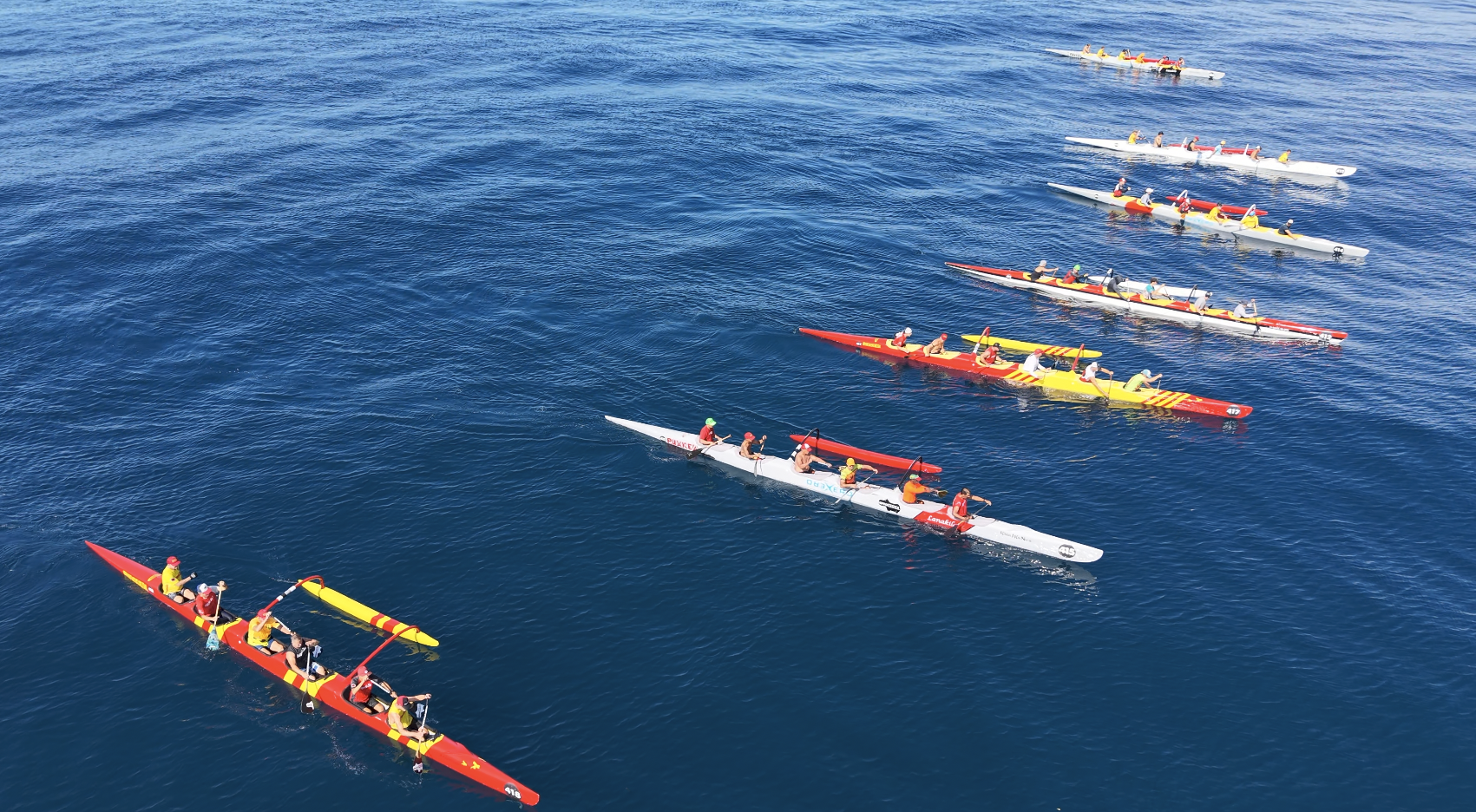
The escort boats make the procession particularly distinctive. Every competitor must provide an escort boat meeting race safety requirements, so what approaches the Peninsula isn't simply a line of paddleboards. It can look like a moving flotilla.
Families, friends, navigators and support crews trail alongside the paddlers while maintaining the required separation. From shore, the boats help reveal the scale of the race long before you can clearly distinguish the athletes themselves.
Our family watches the race from the Palos Verdes bluffs every year. Seeing the paddlers so far out in the ocean — and realizing they're still racing rather than merely trying to finish — gives you a completely different appreciation for what they're doing.
The boats behind them are part of the scene too. There is this whole community traveling with the race, cheering and supporting athletes all the way from Catalina to Manhattan Beach. It's one of those distinctly South Bay sights that is difficult to fully appreciate until you've watched it in person.
The Endurance Challenge
How Hard Is the Catalina Classic?
The short answer: extremely hard.
Even experienced endurance athletes shouldn't mistake the Catalina Classic for simply covering 32 miles on a paddleboard.
The challenge comes from the combination of distance, repetitive upper-body movement, body position, navigation and an ocean environment that can change dramatically from one year to another.
Five to Nine Hours of Racing
Elite Unlimited paddlers can finish around five hours in fast conditions. Many competitors spend six, seven or eight hours on the water. The official race cutoff is nine hours.
Continuous Upper-Body Work
The athlete repeatedly reaches, catches the water and pulls the board forward thousands upon thousands of times. Shoulders, lats, chest, arms and trunk absorb an enormous workload.
No Predictable Surface
A road marathon gives runners a relatively stable course. The Catalina Channel can give a paddler headwinds, following swells, cross chop, currents or combinations of all four.
Navigation Matters
The shortest theoretical line isn't always the fastest real-world line. Currents and wind can push a racer off course, making the escort captain and navigation strategy critically important.
Nutrition While Moving
Racers must fuel and hydrate without materially interrupting momentum. Race rules allow nourishment from the escort crew under specific safety restrictions.
Mental Endurance
Open water offers few landmarks. Hours of repetitive paddling while staring across the ocean demands concentration, patience and the ability to tolerate discomfort.
There is another factor spectators sometimes underestimate: unlike running or cycling, prone paddling is highly specialized. Being aerobically fit isn't enough. The shoulders, hands, trunk, neck, hips and skin all have to become accustomed to hours on a board.
That's why experienced paddlers emphasize time on the water. Technique and durability matter almost as much as raw cardiovascular fitness.
What Spectators Notice
How Fast Do Catalina Classic Paddlers Actually Go?
One of the most surprising things about seeing the race in person is the speed.
Jack Bark's 2024 overall course record of 4:54:45 for approximately 32 miles works out to an average speed of roughly 6.5 miles per hour across the entire crossing.
That average includes hours of exposure to currents, swell, wind and changing sea conditions.
The previous overall benchmark had stood for a quarter century: Tim Gair's 5:02:12 record from 1999.
Stock boards can also be extraordinarily fast. The current official Stock record listed by the race organization is Lachie Lansdown's 5:35:00 from 2024.
What makes those times remarkable isn't a brief sprint. Elite paddlers are sustaining efficient movement for nearly five hours while reading and using the ocean beneath them.
| Historic Benchmark | Athlete | Time | Year |
|---|---|---|---|
| Current Unlimited Record | Jack Bark | 4:54:45 | 2024 |
| Former Unlimited Record | Tim Gair | 5:02:12 | 1999 |
| Current 12' Stock Record | Lachie Lansdown | 5:35:00 | 2024 |
| First Organized Race | Ricky Grigg | 8:27:14 | 1955 |
The Athletes
Who Does the Catalina Classic?
The Catalina Classic attracts a fascinating mix of elite paddlers, lifeguards, surfers, ocean athletes, endurance competitors and dedicated amateurs.
Its roots remain deeply connected to Southern California lifeguard culture, but the modern event attracts competitors from well beyond the South Bay and California.
Recent fields illustrate how substantial the race has become. Official timing data listed 130 racers in 2024 and 134 in 2025.
This isn't, however, an open fun run where anyone can register and show up.
Race directors evaluate eligibility and may require competitors to demonstrate their ability through qualifying races. Recent qualification pathways have included races ranging from shorter regional events to long-distance challenges such as Rock 2 Rock and Molokai 2 Oahu.
Returning Catalina Classic athletes may pre-qualify by finishing within a specified time relative to their class winner, while other entrants submit race results for consideration.
The intent is straightforward: before someone commits to crossing more than 30 miles of open Pacific Ocean, organizers want evidence that the athlete can safely and competitively handle the challenge.
Elite Ocean Athletes
The front of the race includes highly specialized paddlers capable of sustaining extraordinary speeds across the channel.
Lifeguards & Watermen
The race's history remains intertwined with Southern California lifeguard culture and the broader waterman tradition.
Committed Age-Group Athletes
The field includes experienced endurance paddlers across a wide age range who spend months preparing simply to earn the opportunity to finish the crossing.
Official rules generally require competitors to be at least 18, although exceptions may be granted with parental approval. There are no separate age-group competitions. Awards are organized primarily by board class and gender when participation requirements are met.
More Than One Athlete
Is the Catalina Classic a Team Race?
Officially, the Catalina Classic is an individual race rather than a relay.
But calling it an individual effort doesn't tell the whole story.
Every paddler must provide an escort boat equipped to race standards, including required communication, navigation and U.S. Coast Guard-approved safety equipment. The escort crew is responsible for following the athlete across the channel while observing strict safety and drafting rules.
The right captain and crew can be enormously important.
They help navigate. They watch changing conditions. They prepare hydration and calories. They communicate with the paddler. They monitor safety. And after hours alone on a board, they're often the athlete's closest connection to the outside world.
The Paddler
Supplies every stroke and ultimately makes the tactical decisions required to race the course.
The Escort Captain
Handles the support vessel, navigation, communications and safe positioning around the athlete and other boats.
The Support Crew
Helps with nutrition, hydration, logistics, encouragement and the dozens of small details involved in spending most of a day offshore.
This is why the boats are such an important part of the spectacle from shore. You're not simply watching individual athletes. You're watching dozens of little teams moving together across the Pacific — athlete, captain, crew, family and friends — all trying to get one person safely and quickly to Manhattan Beach.
Equipment
Stock vs. Unlimited Paddleboards
Catalina Classic competitors race in two principal board classifications: Stock and Unlimited.
| Feature | Stock Class | Unlimited Class |
|---|---|---|
| Maximum Length | 12 feet | No specific maximum under current race rules |
| Typical Race Board | Compact traditional race board | Often approximately 18–19 feet |
| Steering | Stationary fin; no tiller | Rudders and tillers permitted |
| Foils | Not permitted | Not permitted |
| SUP | Not permitted | Not permitted |
| Propulsion | Hands and arms | Hands and arms |
Unlimited boards are longer, narrow and designed to move efficiently through open water. Steering systems can help athletes manage crosswinds and swell without wasting as much energy correcting direction.
Stock racing places athletes on shorter 12-foot boards without steering tillers, creating its own tactical and technical challenge.
Both require considerable skill. A longer board doesn't make 32 miles of open-ocean paddling easy; it simply changes how an athlete attacks the course.
Preparing for 32 Miles
How Do Athletes Train for the Catalina Classic?
Serious Catalina Classic preparation looks much more like training for an ultra-endurance event than preparing for a recreational paddle.
Jack Bark, who owns the current overall course record, has described a Classic-specific build of approximately 10 to 15 weeks followed by a two- to three-week taper. His example training structure includes roughly four paddles each week: shorter sessions incorporating speed work and longer sessions designed to accumulate endurance and time on the board.
Longer training paddles can extend from eight miles toward 20 or even 25 miles as race fitness develops.
Other experienced Classic competitors have described weekly paddle totals reaching roughly 40 to 50 miles during dedicated training periods, although appropriate volume varies considerably by athlete, experience and objective.
Long Endurance Paddles
Build muscular durability, fueling practice, technique under fatigue and comfort spending several hours on the board.
Shorter Speed Sessions
Intervals improve paddling economy, power and an athlete's ability to maintain a stronger race pace.
Open-Ocean Practice
Athletes need exposure to chop, swell, wind and imperfect conditions rather than training exclusively on calm water.
Strength & Mobility
Trunk stability, shoulders, back, hips and legs all contribute to effective prone and knee paddling.
Swimming & Cross-Training
Many paddlers supplement board work with swimming, rowing, running or gym training to develop general aerobic capacity and durability.
Nutrition Rehearsal
Athletes practice taking fluids, carbohydrates and electrolytes while continuing to move so race-day feeding becomes routine.
Like most long endurance races, successful training is also about resisting the temptation to do too much too quickly.
The athlete needs enough training to tolerate the distance without arriving at race weekend exhausted or injured. Because prone paddling places such repetitive stress on the shoulders and upper body, progressive adaptation is especially important.
From an endurance-coaching perspective, what fascinates me about the Catalina Classic is how specific the fitness has to be. Someone can be extremely aerobically fit and still be completely unprepared to paddle efficiently for six or seven hours.
The athletes at the front aren't simply strong. They're economical. Thousands of strokes have to be technically repeatable, and nutrition, pacing, ocean reading and durability all need to work together.
More Than a Race
Why the Catalina Classic Matters to the South Bay
Plenty of endurance races are impressive because of their distance.
The Catalina Classic is unusual because its geography gives it a connection to so many coastal communities at once.
It begins on Catalina Island, a landmark visible from much of coastal Los Angeles on a clear day. It then crosses one of Southern California's most recognizable stretches of open water.
The race returns toward the Palos Verdes Peninsula and then moves north along the South Bay coastline, creating opportunities for residents around Palos Verdes, Torrance Beach, Redondo Beach and Hermosa Beach to see the race before its iconic finish in Manhattan Beach.
That geographic progression gives the Classic a sense of movement through the region rather than simply movement across a racecourse.
Palos Verdes
The elevated bluffs offer a remarkable perspective on the scale of the crossing and the flotilla moving through the ocean below.
Redondo & Hermosa
The race moves into increasingly familiar South Bay waters as competitors make the final push north.
Manhattan Beach
The Manhattan Beach Pier provides the historic finish and remains the emotional center of the event.
The race association has also made donations to local nonprofit organizations associated with youth programs, education, marine life and water safety, including organizations such as the Los Angeles County Junior Lifeguard Scholarship Fund, Manhattan Beach Roundhouse Aquarium, Jimmy Miller Memorial Foundation and Cabrillo Marine Aquarium.
In that sense, the Classic isn't only about preserving an old sporting tradition. It also reinforces the water culture that has shaped the identity of the South Bay for generations.
To me, this is one of those events that explains the South Bay better than any marketing description ever could. Ocean, endurance, lifeguard culture, families on the bluffs, boats offshore, people gathering around the Manhattan Beach Pier — it connects the communities we live in through one enormous day on the water.
Watching the Race
Where Can You Watch the Catalina Classic?
The best place to watch depends on which part of the race interests you most.
Palos Verdes Bluffs
Best for understanding the scale of the event. From elevated coastal viewpoints, spectators may see the escort fleet and racers as the field approaches and rounds the offshore portion of the Palos Verdes course.
South Bay Beaches
Depending on conditions and the field's line, spectators along Torrance, Redondo and Hermosa can sometimes follow portions of the northbound progression.
Manhattan Beach Pier
Best for atmosphere and the finish. The first racers traditionally arrive around late morning, while the remainder of the field continues finishing through the afternoon.
Because racers are offshore and their precise path is affected by wind, currents, conditions and navigation, visibility from any coastal viewpoint varies from year to year.
Race schedules, start times and spectator expectations should always be confirmed with the official Catalina Classic organizers before race day.
The Question Everyone Asks
Why Would Anyone Want to Paddle 32 Miles Across the Pacific?
There is no single answer.
Some competitors are chasing the podium. Some are continuing a lifeguard or family tradition. Some grew up watching the race. Some want to test themselves against one of the benchmark events in paddleboarding.
And some return again and again because of the community surrounding the race.
Veteran competitors have spoken publicly about camaraderie being one of the reasons they continue returning even after initially planning to complete the Classic only once.
That makes sense when you see the event in context.
Preparation can consume months. Competitors train together before sunrise, travel to qualifying races, recruit escort crews, organize boats and logistics, arrive on Catalina and then spend most of race day moving together across the same enormous stretch of water.
Finishing the Classic therefore means more than checking off 32 miles.
It means joining a tradition that stretches back through generations of South Bay lifeguards, surfers, paddleboard builders and ocean athletes.
Cliff's Notes
What Makes the Catalina Classic Special
It's legitimately enormous.
Thirty-two miles across exposed ocean puts the Classic firmly in ultra-endurance territory.
They're racing, not merely surviving.
The leaders average speeds that look astonishing when viewed from shore, especially after several hours of paddling.
The ocean determines the race.
Wind, swell and current can dramatically change the challenge from one year to another.
Every paddler has a support team.
The escort fleet is a required safety component and one of the most visually memorable elements of the race.
It has real South Bay history.
The organized race dates to 1955, with even earlier Catalina paddleboard crossings dating to 1932.
It connects communities.
Few events so naturally tie Catalina, Palos Verdes, Torrance, Redondo, Hermosa and Manhattan Beach together in one experience.
Frequently Asked Questions
Catalina Classic Paddleboard Race FAQ
How long is the Catalina Classic Paddleboard Race?
The Catalina Classic is approximately 32 miles from Isthmus Cove near Two Harbors on Catalina Island to the Manhattan Beach Pier.
Where does the Catalina Classic start?
The race traditionally begins at Isthmus Cove near Two Harbors on Catalina Island.
Where does the Catalina Classic finish?
The race finishes in the water immediately south of the Manhattan Beach Pier.
Do Catalina Classic racers use paddles?
No. This is prone paddleboarding rather than stand-up paddleboarding. Athletes propel their boards with their hands and arms.
How long does it take to finish the Catalina Classic?
Elite racers can finish close to five hours in favorable conditions, while many competitors spend six to eight hours on the course. Current race rules set a nine-hour cutoff.
What is the Catalina Classic course record?
Jack Bark set the official Unlimited course record of 4:54:45 in 2024, breaking Tim Gair's 1999 record of 5:02:12.
How many people compete in the Catalina Classic?
Participation changes each year. Recent official timing results recorded 130 racers in 2024 and 134 racers in 2025, making a field of roughly 130 competitors a useful recent reference point.
Does every Catalina Classic paddler have a support boat?
Yes. Under current race rules, each paddler must provide an escort boat meeting required communications, navigation and safety standards.
Why are there so many boats following the race?
Each competitor has an escort boat, while race organizers also operate safety and official vessels. The resulting fleet is why the event can look like a procession of boats when viewed from the Palos Verdes coastline.
Does the Catalina Classic pass Palos Verdes?
Yes. The official course directs paddlers toward the PV-10, also known as the R-10, buoy offshore from the Palos Verdes Peninsula before the race continues generally north toward Manhattan Beach.
Can you watch the Catalina Classic from Palos Verdes?
Often, yes. Elevated viewpoints along the Palos Verdes coastline can provide impressive views of the racers and escort fleet, although exact visibility and timing depend on weather, ocean conditions and the racing line used that year.
What is the difference between Stock and Unlimited paddleboards?
Stock boards have a maximum length of 12 feet and use stationary fins without steering tillers. Unlimited boards have far fewer dimensional restrictions and may use rudders and tillers. Unlimited race boards are commonly much longer than Stock boards.
Can anyone enter the Catalina Classic?
Entry is subject to race director approval and qualification requirements. Competitors may need to demonstrate suitable experience and performance through designated or comparable paddleboard races.
When did the Catalina Classic begin?
The organized race began in 1955 as the Manhattan Beach International Paddleboard Race. After an extended hiatus, it was revived in 1982 as the modern Catalina Classic.
Why is the Catalina Classic important to Manhattan Beach and the South Bay?
The race grew directly from Southern California lifeguard and waterman culture and has been connected to Manhattan Beach for generations. Its course also visually links Catalina Island, Palos Verdes and the South Bay beach cities, making it both an endurance event and an enduring piece of local coastal culture.
Learn More
Official Race Information & Historical Sources
Race logistics, qualifying standards, schedules, course rules and participation can change. For the latest race-year information, visit the official Catalina Classic Paddleboard Race website.
Living in the South Bay
Local Knowledge Goes Beyond Real Estate
Events like the Catalina Classic are part of what makes living along the Palos Verdes Peninsula and South Bay coastline so distinctive. For questions about Palos Verdes, Redondo Beach, Hermosa Beach, Manhattan Beach or surrounding South Bay communities, connect with Scherb Homes Group.
Contact Scherb Homes Group