Going Solar in Palos Verdes: Our Family’s Real Experience, Costs & Lessons Learned

Cliff’s Notes | South Bay Homeownership
Going Solar in the South Bay: What We Learned From Planning Our Own System
Our personal experience designing a 42-panel solar system with three home batteries, replacing a tile roof and navigating the practical decisions that come with solar in Palos Verdes Estates.
I have wanted to add solar to our Valmonte home for years, but our roof, mature trees and neighborhood conditions made the decision more complicated than it initially appeared. After nearly six months of research, design work and planning, we are moving forward. I am sharing the experience to help South Bay homeowners and buyers understand what may be involved before they begin.
Why We Finally Decided to Go Solar
Our electricity needs changed substantially, while improvements to the property made solar more viable than it had been in the past.
For a long time, solar did not make practical sense for our home. We live in Valmonte, a beautiful, tree-filled neighborhood in Palos Verdes Estates. The mature eucalyptus and other established trees that give the area so much of its character can also limit the direct sunlight reaching a roof.
Our lightweight cement-composite roof tiles added another complication. The tiles crack easily when walked on, and the roof was not considered well suited to the type of solar installation we were exploring. That meant we could not simply select a system and attach it to the existing roof.
Over time, however, the financial and practical reasons for reconsidering solar became stronger. We now have two electric vehicles, recently added air conditioning and use a jacuzzi. Electricity prices have also continued to rise. Together, those factors increased our household energy consumption and made the potential value of generating and storing our own power much more compelling.
We also trimmed several trees, allowing more sunlight to reach the roof. Once the available sunlight improved and our electrical usage increased, the project began to make sense.
Solar is not simply a question of whether your roof receives sunlight. The decision should account for your roof material, tree coverage, household usage, electric vehicles, future improvements, utility rates, battery capacity and how long you expect to own the home.
Our Proposed Solar and Battery System
The design is larger than a typical residential system because it must account for shade, current energy use and anticipated future demand.
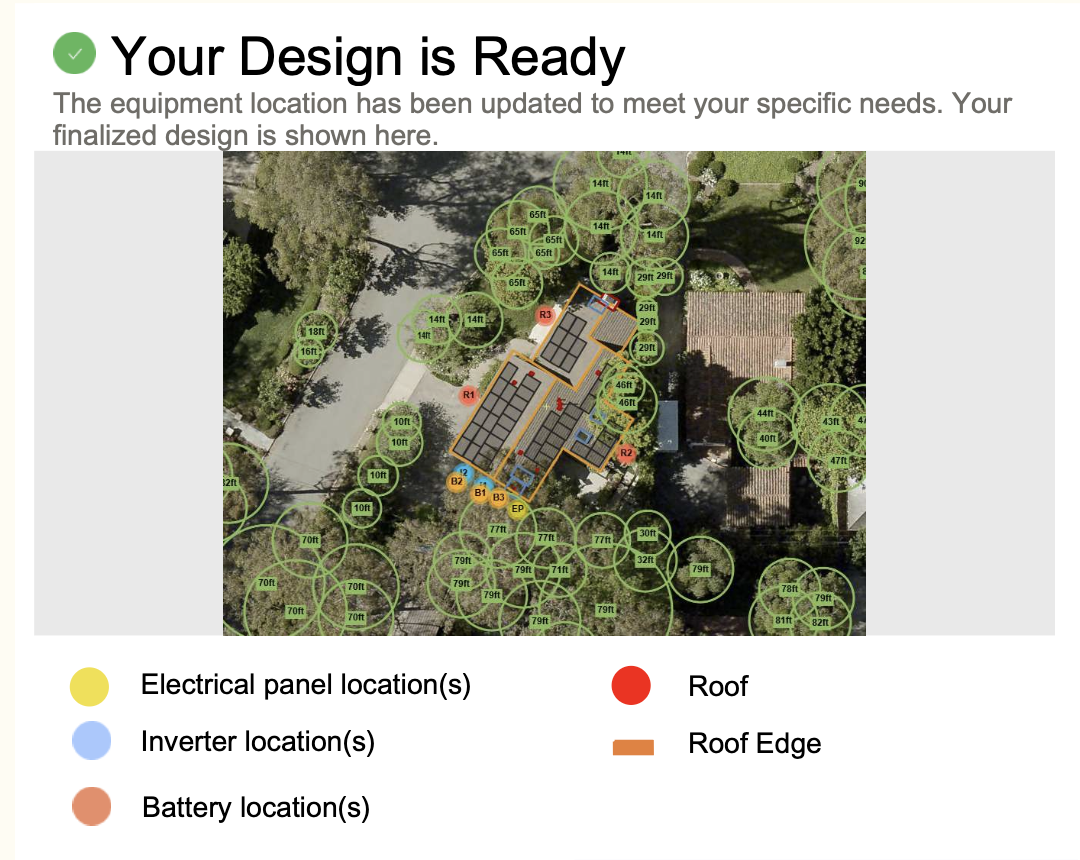
After meeting with a Sunrun representative and evaluating the available roof surfaces, we arrived at a proposed design containing 42 solar panels. That number may sound excessive for one home, but the system was intentionally sized to compensate for possible production losses caused by surrounding trees and changing sunlight throughout the year.
We also wanted enough capacity to accommodate our existing electrical consumption and the additional demand created by our air conditioning, jacuzzi and two electric vehicles. The agreement guarantees approximately 17,500 kilowatt-hours of annual production, representing about 108% of our current measured usage.
That additional margin is important. A solar design based only on yesterday’s electricity use can become undersized if a homeowner later adds an electric vehicle, heat pump, air conditioning, pool equipment, an accessory dwelling unit or other substantial electrical loads.
The Unexpected Roof Component
In our case, the solar project became a roofing project as well.
Our roof was only about seven years old, so replacing it was not part of our original plan. Unfortunately, its lightweight cement-composite tiles weighed approximately six pounds each and were too fragile for the installation approach being proposed. The tiles would need to be replaced with heavier, more durable tiles weighing approximately nine pounds each.
Before proceeding, the additional roof weight had to be evaluated. Engineering review indicated that the home could support the proposed roofing material and solar system. We also had to select a new roof color, which introduced another design decision into a project that initially seemed to be only about electricity.
Replacing a relatively new roof felt redundant. Sunrun was able to contribute additional money toward the roofing work, bringing our total out-of-pocket cost for reroofing the entire home to approximately $10,000. Given the scope of the work and the long-term plan for the property, we felt that was a reasonable outcome.
Why Roof Type Matters
- Some tiles can crack when walked on.
- Mounting methods vary by roofing material.
- Removing and reinstalling panels for a later reroof can add cost.
- Roof age should be compared with the expected life of the solar system.
Questions We Had to Resolve
- Could the structure support the added weight?
- Would the replacement tiles be visually appropriate?
- Who would coordinate the roof and solar warranties?
- How would the reroof affect the installation timeline?
Evaluate the roof before evaluating the solar proposal. A low monthly solar payment can look attractive until a homeowner discovers that the roof needs substantial work before installation can begin.
The Economics of Our Decision
We compared the proposed lease payment with our current electricity expense while also considering maintenance, battery replacement and future energy consumption.
| Financial Component | Our Situation | Why It Matters |
|---|---|---|
| Current electricity cost | Approximately $550 per month averaged across the year | Includes household electricity and charging two electric vehicles |
| Initial lease payment | Approximately $385 per month | Creates an initial reduction compared with our present average utility expense |
| Annual escalator | 3.5% per year | The payment increases annually and must be modeled over the full term |
| Lease term | 25 years | A long-term agreement can affect refinancing, ownership changes and a future sale |
| Roof contribution | Approximately $10,000 total homeowner cost for the reroof | The solar provider’s contribution reduced a major upfront project expense |
| Initial promotion | Approximately $500 per month credited for the first six months | Improves the near-term economics but should not replace full-term analysis |
| Purchase option | Our agreement allows a future buyout | We may consider purchasing around the time the batteries are replaced |
Our current electricity expense averages approximately $550 per month over the course of a year. That is substantial, but it also reflects more than ordinary household use. It includes much of our family’s vehicle transportation because both vehicles are charged at home.
Under our proposed Sunrun lease, the starting monthly payment is approximately $385. The agreement runs for 25 years and includes a 3.5% annual escalator. We also expect a promotional credit of approximately $500 per month for the first six months.
The initial difference between $550 and $385 is attractive, but the annual escalator is important. A homeowner should not evaluate a solar lease based solely on the first-year payment. The appropriate comparison is the projected total cost of the agreement against reasonable assumptions for future utility rates, maintenance, equipment replacement and household usage.
A 3.5% Escalator Changes the Long-Term Payment
At a 3.5% annual increase, a $385 starting payment would rise over time. The exact billing schedule and rounding will depend on the contract, but the cumulative effect should be reviewed carefully before signing.
The decision may still be financially sound, particularly when compared with increasing utility costs and when service, monitoring and battery replacement are included. The key is to assess the entire agreement rather than focusing only on the introductory payment.
Why We Chose to Lease Instead of Buy
We valued long-term service and equipment support more than immediate ownership, although the right choice will differ by household.
Why Leasing Appealed to Us
- Sunrun remains responsible for system serviceability under our agreement.
- Monitoring and long-term maintenance are included.
- The arrangement reduced the immediate capital required for the project.
- Our agreement includes battery replacement provisions.
- We retain an option to purchase the system later.
Reasons Another Owner May Prefer Buying
- Direct ownership without a long-term lease obligation.
- No annual lease-payment escalator.
- Potential access to ownership-related tax benefits, subject to eligibility.
- A potentially simpler future home sale if the system is owned outright.
- Greater control over equipment and service providers.
We chose to lease because we wanted the provider to remain responsible for keeping the system operating over the years. Solar equipment is designed for long-term use, but inverters, batteries, monitoring equipment and other components may require attention during a 25-year period.
Under our agreement, the three batteries are expected to be replaced around the end of their useful service period, anticipated at approximately 10 years. We are considering buying the system around that point, after the replacement batteries have been installed.
That is specific to our agreement and should not be assumed to apply to every lease. Homeowners should read the actual contract provisions covering battery capacity, degradation, replacement thresholds, labor, roof penetrations, removal and reinstallation, transfer requirements and buyout calculations.
Leasing can make sense when service and equipment responsibility are priorities. Buying can make sense when long-term ownership, tax treatment and avoiding an escalator are more important. The answer is not universal.
Why We Increased the System to Three Batteries
The batteries were one of the most compelling parts of the project because they allow us to store more of the energy produced at the home.
The initial recommendation included two Tesla Powerwalls. We chose to add a third. Our goal is to retain more of the power generated during the day, use it when utility electricity is more expensive, charge our vehicles and maintain additional backup capacity during an outage.
California’s current Solar Billing Plan generally places greater value on using solar electricity within the home than on exporting excess electricity to the grid. Exported power can still produce bill credits, but the value varies by time and is not necessarily equal to the retail price a homeowner pays when drawing electricity from the utility.
That makes storage a central part of the modern solar conversation. Panels generate electricity, but batteries help determine when that electricity can be used.
Use More Solar at Home
Store daytime production for evening household use rather than immediately sending all excess production to the grid.
Support Vehicle Charging
Stored energy may help offset some of the electricity used to charge electric vehicles, depending on charging schedules and battery settings.
Prepare for Outages
Properly configured batteries can supply designated loads during a power outage, subject to system capacity and household demand.
For a new California solar installation, I would spend as much time understanding battery capacity, backup configuration and energy-management settings as I would comparing the panels themselves.
What the Planning and Installation Process Has Involved
Our project has taken approximately six months of research, coordination and design work before installation.
Review Household Energy Use
We examined our annual electricity consumption, electric-vehicle charging and expected future demand from air conditioning and other equipment.
Evaluate Sunlight and Tree Coverage
Tree trimming improved solar exposure, but the system still needed to account for periods of shade and seasonal changes in sunlight.
Assess the Existing Roof
The fragile lightweight tiles were determined to be unsuitable for the planned installation, triggering a full reroof.
Complete Structural and Engineering Review
The proposed heavier roofing material and solar equipment had to be evaluated for structural compatibility.
Design the Panel and Battery Layout
The final proposed layout contains 42 panels and three home batteries, with panels distributed across usable roof surfaces.
Review Local and Association Requirements
Homes in Palos Verdes Estates may involve City permitting as well as review associated with the Palos Verdes Homes Association. Requirements should be confirmed for the specific property and scope of work.
Coordinate Roofing and Solar Installation
Our current plan is to complete the reroof in mid-July 2026 and install the solar system near the end of July 2026, subject to approvals, scheduling and field conditions.
Inspection, Interconnection and Activation
After installation, the system must pass applicable inspections and complete the utility interconnection process before normal operation begins.
Communication has sometimes moved more slowly than we expected. At the same time, this was not an emergency project, and we intentionally took our time reviewing the design, roof work and financial terms.
Anyone considering solar should expect multiple participants: the sales representative, solar designer, roofing contractor, engineer, permitting authority, utility and possibly a homeowners association or architectural review organization. Clarifying who is responsible for each step can prevent confusion later.
The Aesthetic Tradeoff
Some of our panels will be visible from the front of the home, which remains our primary hesitation.
In neighborhoods known for architecture, established landscaping and carefully maintained streetscapes, solar is not only a financial or environmental decision. It can also be a design decision.
Some of the panels in our proposed layout will need to be installed on the front-facing portion of our roof. We would prefer to conceal every panel from the street, but doing so would reduce the production available from the system and could undermine the purpose of the project.
We ultimately concluded that the benefits to our family, the resilience provided by battery storage and the environmental value of producing more of our own electricity outweighed our concern about seeing the panels.
Ways to Improve the Appearance
- Use a clean, symmetrical panel layout when possible.
- Coordinate panel and mounting colors with the roof.
- Consolidate conduit and electrical equipment thoughtfully.
- Review street-level renderings before final approval.
- Consider future tree growth when positioning panels.
Questions to Ask Before Approving a Layout
- Which panels will be visible from the street?
- How much production is lost if panels are relocated?
- Where will batteries and electrical equipment be installed?
- Will the design comply with local placement and clearance rules?
- Can the layout affect future roof repairs?
Solar Considerations Across the South Bay
Solar viability can change from one property to the next, even within the same neighborhood.
Palos Verdes Estates and Valmonte
Mature trees, older roofs, architectural review, sloped lots and varied roof orientations can make design more complex. Valmonte’s eucalyptus canopy may reduce production on some properties while sunnier roof exposures can perform well.
Rancho Palos Verdes
Many properties benefit from open exposure and larger roof areas. Coastal fog, hillside orientation, wind exposure and neighborhood-specific association requirements should still be evaluated.
Rolling Hills Estates
Larger lots can provide good sunlight, but mature landscaping and association standards may influence panel visibility, battery placement and tree management.
Redondo Beach and Torrance
Properties with open roof exposure may be strong candidates. Smaller lots, neighboring structures, roof condition and electrical-panel capacity can influence the final design.
Hermosa Beach
High electricity usage and limited roof area can create a design challenge. Roof decks, narrow lots, coastal conditions and neighboring buildings should be considered.
Manhattan Beach
Newer construction may already include solar or solar-ready infrastructure. On existing homes, roof decks, architectural design and available roof area can affect production potential.
California’s Energy Code includes solar photovoltaic requirements for many newly constructed buildings, subject to applicable exceptions and project-specific standards. Existing-home projects remain highly individualized.
A house located in a generally sunny community is not automatically a good solar candidate. The analysis should be completed at the property level using the actual roof planes, shade patterns, electrical usage and local approval requirements.
In the South Bay, the right question is not, “Is this a sunny neighborhood?” It is, “How much usable sunlight reaches this particular roof, during the hours when production will be most valuable?”
What Solar Means for South Bay Home Buyers and Sellers
Solar can be a valuable home feature, but the equipment, ownership structure and contractual obligations should be understood before a transaction.
For Home Buyers
- Confirm whether the system is owned, financed, leased or subject to a power-purchase agreement.
- Request the complete agreement, payment schedule and transfer instructions.
- Review recent electricity bills and actual production reports.
- Confirm the age, capacity and warranty status of the batteries.
- Determine which household circuits are supported during an outage.
- Ask about roof penetrations, reroofing and panel-removal obligations.
- Verify that permits, inspections and utility approvals were completed.
For Home Sellers
- Collect the contract, warranty, permit and production documentation early.
- Understand whether the buyer must qualify to assume an agreement.
- Calculate any buyout or payoff options before listing.
- Present electricity savings with supporting bills rather than estimates alone.
- Disclose known roof, equipment or performance concerns.
- Explain the battery and backup configuration clearly.
- Prepare for solar-related questions before entering escrow.
Solar can improve a home’s operating story, particularly when it supports electric vehicles, air conditioning and backup power. However, buyers may view an owned system differently from a 25-year agreement with an escalating payment.
A well-documented system is easier to evaluate and explain. Before selling, homeowners should assemble the original contract, amendments, warranties, equipment specifications, permit records, utility approval, recent production reports and electricity bills.
For owners considering a future move, it can also be helpful to discuss the home’s broader preparation and positioning strategy before investing in a major energy project. Visit our South Bay home-selling resource or contact Scherb Homes Group to discuss how improvements may fit into a long-term property plan.
Our Most Important Takeaways So Far
We have not yet seen a full year of production, but the planning process has already taught us several useful lessons.
- Start with actual annual electricity use. Include vehicle charging and any equipment you plan to add.
- Model future demand. Air conditioning, additional electric vehicles, pool equipment and accessory dwelling units can materially change consumption.
- Inspect the roof first. Roof age, material and structural capacity may affect both cost and feasibility.
- Account for trees throughout the year. A sunny roof inspection on one day does not tell the entire production story.
- Evaluate batteries carefully. Storage capacity and backup configuration can be as important as panel count.
- Read the full contract. Review escalators, transfer requirements, buyout provisions, warranties and replacement obligations.
- Do not rely only on first-year savings. Compare projected costs across the expected ownership period.
- Review the street-facing design. Ask for a clear rendering of panel, conduit, battery and equipment placement.
- Expect multiple approvals. City, utility and association processes can all affect the schedule.
- Keep every project record. Complete documentation will matter during service, refinancing and a future sale.
Solar is not one product. It is a long-term combination of roofing, electrical infrastructure, financing, utility policy, battery storage, home design and future property plans.
Frequently Asked Questions About Going Solar in the South Bay
These answers reflect our personal experience and general homeowner considerations. Requirements and financial terms vary by property, provider, utility and agreement.
Is solar worthwhile in Palos Verdes Estates?
It can be, but the answer is property-specific. Mature trees, roof orientation, coastal weather, architectural considerations, electricity consumption and roof type can all affect feasibility. A detailed shade and production analysis is more useful than a neighborhood-wide assumption.
Can a home with mature trees still use solar?
Potentially. The system may require strategic panel placement, tree maintenance, additional panels or a different financial analysis to account for lower production. Tree work should be evaluated carefully and completed in compliance with applicable local rules.
Why does our proposed system have 42 panels?
Our design must cover substantial household usage, two electric vehicles, air conditioning, a jacuzzi and possible production losses caused by trees. The system is intended to produce approximately 17,500 kilowatt-hours annually and cover about 108% of our present usage.
Why did we choose three batteries instead of two?
We wanted to store more of our daytime solar production, support evening use and vehicle charging, and maintain greater backup capacity during an outage. Actual backup duration will depend on household demand, battery state of charge and which circuits are connected.
Will solar eliminate the utility bill completely?
Not necessarily. Grid-connected customers can continue to receive utility charges, and actual bills depend on consumption, production, battery operation, rate plans, exported energy credits and applicable fees. A proposal showing 100% usage offset does not automatically guarantee a zero-dollar utility bill.
Is it better to lease or buy solar panels?
It depends on available capital, tax circumstances, desired maintenance responsibility, expected ownership period and the terms of the proposed agreement. We selected a lease because service and battery replacement provisions were important to us, but another homeowner may prefer direct ownership.
What should a homeowner look for in a solar lease?
Review the initial payment, annual escalator, total term, transfer process, buyout formula, production guarantee, roof obligations, equipment warranties, battery-replacement language, service response and what happens if the system must be removed temporarily.
Does a solar lease complicate selling a home?
It can add another step. The buyer may need to assume the agreement, satisfy the provider’s requirements or negotiate a buyout or payoff. Sellers should collect the documents and understand the available options before listing the property.
Should an older roof be replaced before installing solar?
Often it is worth considering. Removing and reinstalling panels for a reroof can create additional cost and coordination. The remaining life of the roof should be compared with the expected life and contract term of the solar system.
Are solar panels required on new California homes?
California’s Energy Code includes solar photovoltaic requirements for many newly constructed residential buildings, although exceptions and project-specific rules apply. Homeowners, builders and buyers should verify the standards in effect for the particular permit and project.
How long does a South Bay solar project take?
The timeline can range considerably. Roof work, engineering, system design, association review, City permitting, installation, inspection and utility approval can all affect completion. Our project has involved approximately six months of planning before the anticipated installation.
Will solar increase the value of a South Bay home?
Buyers may value lower operating costs, updated roofing, battery storage and outage protection. The effect on marketability can depend on whether the system is owned or leased, its age and condition, the payment obligation, documentation and the appearance of the installation.
We Will Share What We Learn After the System Is Operating
We are excited about the possibility of producing and storing much of our own electricity while supporting our vehicles and household energy needs. At the same time, we recognize that the real test will be how the system performs through different seasons and usage patterns.
Once the reroof, panel installation, battery installation and utility activation are complete, I plan to update this guide with actual production, utility costs, battery performance and anything we would do differently.
For homeowners considering solar as part of a renovation, future sale or long-term ownership plan, Scherb Homes Group can help you think through the real estate side of the decision and connect the improvement to your broader property goals.