Mike Jones on Family, Baseball and Life in Rancho Palos Verdes

Cliff’s Notes: Voices of the Neighborhood
Mike Jones on Raising a Family, Coaching Baseball and Building a Life in Rancho Palos Verdes
A longtime resident reflects on Rock Valley Road, neighborhood life near Peninsula Center, youth sports, family traditions and the quiet qualities that have kept generations of homeowners on the Palos Verdes Peninsula.
Maps can show where a street begins and ends. Real estate data can tell us when a house was built, how large it is and what it last sold for. But neither can fully explain what it feels like to raise a family on a quiet cul-de-sac, recognize nearly every neighbor or watch a community mature over several decades.
That is the purpose of Cliff’s Notes: Voices of the Neighborhood, an ongoing oral-history project featuring the people who know South Bay and Palos Verdes neighborhoods from lived experience. Through relaxed conversations with longtime residents, community leaders, educators, business owners and other local voices, the series preserves the stories that rarely appear in public records.
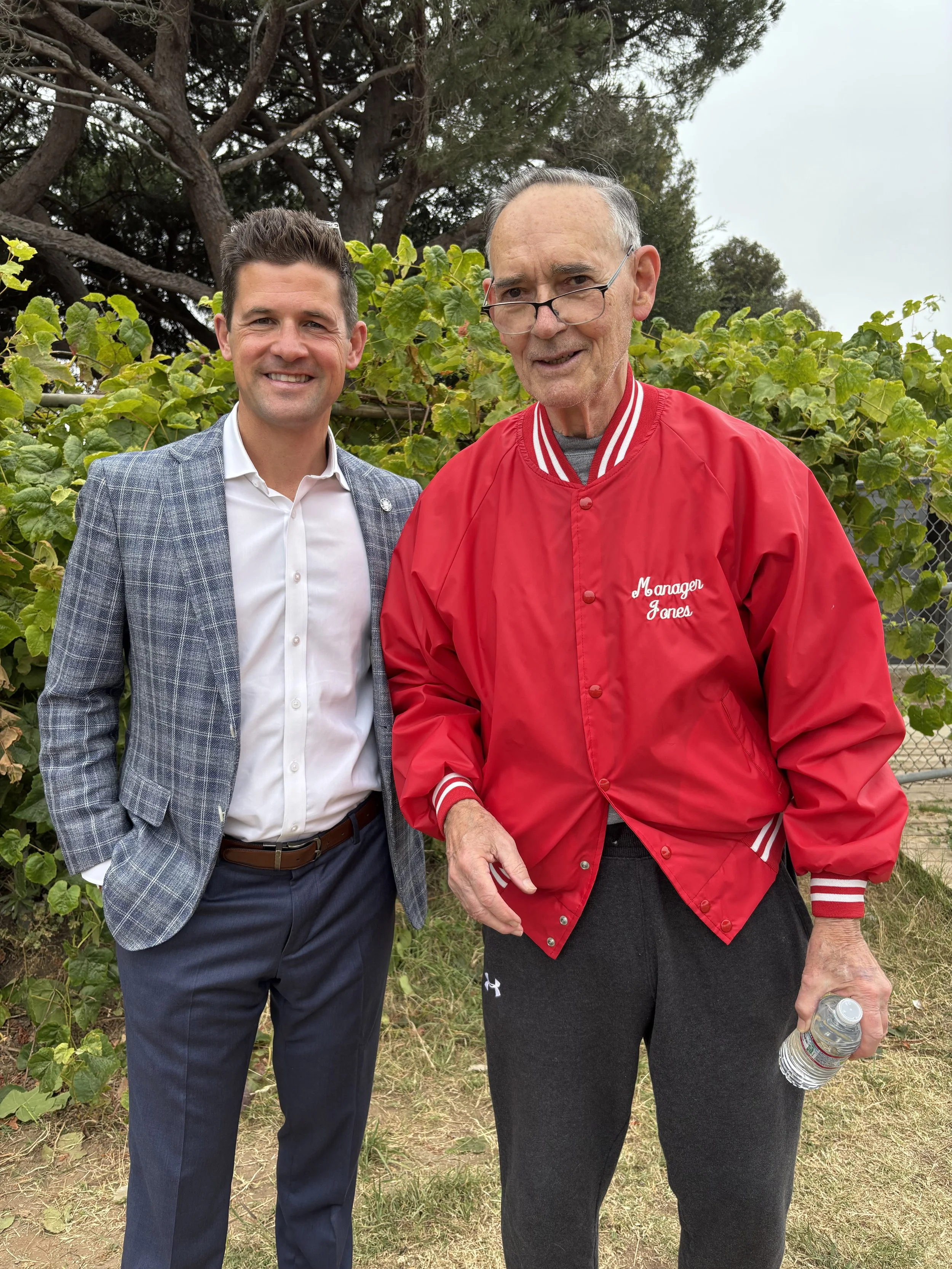
For this conversation, I sat down with my father-in-law, Mike Jones, at the Rancho Palos Verdes home where he and his wife, Betty, raised their family. Their daughter Kimberly is my wife, and their son Jason grew up here alongside her. Mike’s memories connect the home, the street and the surrounding Peninsula community to a much larger story about family life in Rancho Palos Verdes.
The Project
What Is Cliff’s Notes: Voices of the Neighborhood?
Cliff’s Notes: Voices of the Neighborhood is an ongoing oral-history series that captures the memories, observations and firsthand experiences of the people who know a community best: its residents.
These conversations add human context to the local knowledge found throughout the Scherb Homes Group Neighborhoods and Communities Library . They help current residents preserve their history while giving future residents a deeper understanding of the places they may one day call home.
Cliff’s Notes Take
The most valuable neighborhood knowledge is often held by people who have quietly lived there for decades. Their stories explain why certain streets feel different, how local traditions began and why families decide to stay.
The Resident
Meet Mike Jones
Mike’s story reaches well beyond a single home. It includes decades of family life, youth baseball, neighborhood walking, local friendships and a lifelong connection to sports.
Mike at a Glance
- Longtime Rancho Palos Verdes homeowner
- Father of Kimberly and Jason
- Youth baseball coach for approximately 14 years
- Coach of four championship teams
- Lifelong baseball and San Francisco Giants fan
- Longtime neighborhood walker and familiar local presence
A Life Rooted in Community
Mike first came to the Palos Verdes Peninsula while searching for a family home. He and Betty had been living in Redondo Beach, and with their first child on the way, they began looking for a property that could support the next stage of their lives.
What began as a practical search for bedrooms, space and a workable floor plan ultimately became a long-term commitment to a street, a neighborhood and a community.
Over the years, Mike became part of the fabric of the area: coaching local children, supporting neighborhood families, walking the streets and building relationships with neighbors and the people who serve the community.
Finding Home
Why Rock Valley Road Felt Right
Mike and Betty looked at several homes before finding the one that would become their family’s long-term home.
Their search included properties near the Silver Spur area and other parts of the South Bay. One house had many of the right features but did not quite fit. Another was spacious but had a floor plan that felt overly complicated.
When they arrived at the Rock Valley Road home, Mike immediately noticed several practical qualities that mattered to him. The home offered four bedrooms, three bathrooms and a downstairs bedroom, a feature his mother had always advised him to prioritize in a two-story house.
The home’s interior colors were memorable. Several rooms had been painted in bold shades while one of the owners was away, creating a visual first impression that was difficult to miss. Yet the house itself was exceptionally well cared for. When the family moved in, the floors, cabinets and interior had been cleaned carefully, making the transition easier for Betty while she was expecting their first child.
“This house had four bedrooms, three baths and a bedroom downstairs. Seeing the dead-end street, I liked that. That’s what really drew me to it.”
Cliff’s Notes Take
Buyers often focus first on finishes, views or square footage. Mike’s story is a reminder that street position, floor-plan flexibility and a sense of safety can matter even more over decades of ownership.
Family Life
Raising Kimberly and Jason in Rancho Palos Verdes
For Mike, one of the greatest strengths of the neighborhood was the freedom it gave children to play, explore and grow up among other families.
When the Jones family arrived, the street had more children than it does today. Several nearby homes had multiple boys or girls, creating a built-in network of playmates. Children could play ball, move between homes and spend time outdoors in an environment where parents knew one another.
The winding interior streets also reduced casual pass-through traffic. Visitors unfamiliar with the area sometimes needed help finding their way out, which reinforced the sense that this was a residential pocket rather than a route people used to travel through the Peninsula.
Mike remembered the neighborhood as quiet without feeling isolated. Families shared similar priorities, children played outside and neighbors generally knew who belonged on the street.
“It was great because I felt very safe for the kids. Not too many strangers would come up this street because it’s a dead end.”
The broader Peninsula supported that family-centered lifestyle. Schools, youth programs, local sports and community organizations gave families ways to participate beyond their own block. For the Jones family, this included baseball, Indian Guides and Indian Princess activities, camping trips, visits to Marineland and excursions to Catalina.
Why This Matters to Today’s Buyers
Many buyers searching Rancho Palos Verdes are not simply comparing houses. They are evaluating school access, street traffic, neighborhood interaction, outdoor space, community programs and how daily family life may feel over the next ten or twenty years.
Mike’s experience illustrates why smaller residential pockets near established schools and community centers can remain especially appealing to households seeking stability and long-term connection.
A Long-Held Street
A Neighborhood Where Homeowners Stayed
One of Mike’s strongest observations was how long many families remained in their homes.
For much of the street’s history, turnover was limited. Many of the original or early homeowners stayed for decades, and several neighbors remained in their homes into later life. That longevity created an uncommon level of familiarity.
Neighbors did not have to socialize constantly to feel connected. They recognized one another, knew which children belonged to which households and noticed when something seemed out of place. It was less about formal organization and more about long-term awareness.
“Everybody knows each other. Even though you don’t have to be talking to people all the time, you know them.”
The neighborhood held occasional block gatherings and community events. Mike remembered residents coming together near the short dead-end streets, sometimes for civic-focused events recognizing local police, fire and community leadership.
These gatherings were not elaborate productions. Their significance came from bringing people outside, introducing newer residents to established homeowners and reinforcing the sense that the neighborhood functioned as a community rather than merely a collection of houses.
What Created Stability
- Quiet residential streets
- Long-term owner occupancy
- Families raising children together
- Limited through traffic
- Shared participation in schools and youth programs
- Informal neighbor-to-neighbor awareness
What Longtime Ownership Reveals
When residents remain for decades, it often signals that a neighborhood continues to meet practical and emotional needs across multiple life stages.
It may also mean fewer public sales, less predictable inventory and greater importance placed on local relationships and off-market awareness.
The Community Around the Street
How Peninsula Center Changed Over Time
The residential streets remained relatively stable, but the commercial center of the Peninsula evolved considerably.
When Mike and Betty first lived nearby, Peninsula Center was smaller and more locally focused. Grocery stores and neighborhood services played a larger role, and the commercial area had fewer of the larger stores and professional services found there today.
Mike recalled the mall being remodeled and expanded more than once. Businesses changed, shopping patterns evolved and the center went through periods of growth, slowdown and renewed interest.
One reason the area remained quiet was that the Peninsula historically had limited nightlife. Residents typically left the hill for larger entertainment districts, which kept the commercial core focused primarily on local needs.
Today, Peninsula Center remains an important part of everyday life for nearby neighborhoods. Residents use the area for groceries, dining, medical offices, personal services, fitness, schools and errands without having to leave the Peninsula.
Cliff’s Notes Take
Proximity to Peninsula Center is not about living next to a conventional downtown. Its value is convenience: access to daily services while still returning home to a quiet residential street.
Community Through Sports
Fourteen Years of Coaching Baseball
Mike’s involvement in youth baseball became one of his most meaningful connections to the wider Palos Verdes community.
Mike had loved baseball since childhood, but he had never coached when he first volunteered. He saw that the local league needed coaches, attended the meetings and stepped forward.
His playing experience gave him a strong understanding of the game, but coaching required something different: evaluating young players, creating balanced teams, organizing parents and teaching children how to improve.
Over approximately fourteen years, Mike coached four championship teams. He was fortunate to work with supportive parents, and he learned how much a youth program depends on adults who are willing to contribute time without expecting anything in return.
“I loved baseball. I played baseball from the time I was four. I had never coached before, but they needed coaches, so I volunteered.”
Recognizing Potential Others Missed
During his first year, Mike entered the player draft without the built-in advantage enjoyed by coaches who already had children assigned to their teams. He questioned whether the process created an uneven playing field, but he trusted his own evaluation.
One young player stood out because of his arm. Others believed the child was too young to pitch effectively at that level, but Mike selected him anyway. The player helped the team reach the championship game and later went on to play professional baseball.
The memory stayed with Mike not simply because of what the player achieved, but because it affirmed the importance of looking beyond assumptions and giving a young athlete an opportunity.
Volunteer Leadership
Mike entered coaching because the league needed help, demonstrating how local programs depend on residents who are willing to step forward.
Player Development
His approach centered on recognizing potential, teaching fundamentals and creating opportunities for children to participate.
Community Connection
Baseball introduced Mike to families across the Peninsula and gave him a role in the lives of young players beyond his own household.
Youth sports remain an important part of life across Palos Verdes. Families interested in the history and role of local baseball can also explore the Scherb Homes Group Palos Verdes Little League Guide .
Beyond the Block
Marineland, Catalina and Family Traditions
Some of Mike’s memories reflect a version of the Peninsula that no longer exists physically but remains important to local history.
The Jones family visited Marineland of the Pacific, the marine park that once occupied the coastal site now associated with Terranea Resort. Mike did not recall every detail of the park itself, but he remembered it as part of a larger culture of family outings and organized youth activities.
Mike participated in Indian Guides and Indian Princess programs with Jason and Kimberly. These programs brought parents and children together through camping, group activities and trips, including visits to Catalina and rides on glass-bottom boats.
Those experiences connected neighborhood families to the Peninsula’s coastal setting. The ocean was not simply a view in the distance. It was part of family recreation, weekend traditions and children’s memories.
The Peninsula as a Family Landscape
Rancho Palos Verdes has always offered more than residential privacy. Coastal trails, youth programs, schools, athletic organizations and community gathering places create a broader environment in which families can build traditions.
For longtime residents, these shared experiences often become just as memorable as the house itself.
The Unofficial Neighborhood Patrol
Walking, Watching and Helping
Over time, Mike became one of the most recognizable people in the neighborhood because of his daily walks.
At one point, Mike walked nearly eight miles a day. He later adjusted the distance after a knee injury, but continued walking consistently for years.
These walks were more than exercise. Mike picked up newspapers, noticed open doors, spoke with mail carriers and got to know trash collection crews. He offered water, learned their routines and built the kind of informal relationships that can make a neighborhood feel cared for.
One neighbor gave him a nickname based on his presence in the streets, reflecting his role as an unofficial set of eyes and ears for the block.
“I picked up the papers. I knew the trash people. I would give them water and help with whatever.”
Mike eventually calculated that his cumulative walking distance was comparable to traveling from California to New York and back more than once. He stopped counting after that.
Cliff’s Notes Take
A strong neighborhood is often shaped by ordinary acts repeated over many years: walking the block, knowing the service crews, picking up a neighbor’s paper and paying attention when something seems unusual.
What Maps Cannot Tell You
Local Knowledge: The Red Onion, Back Roads and “Tiger’s Curve”
Every neighborhood has places, routes and stories that residents understand differently than visitors.
The Red Onion
Mike described the Red Onion as a longstanding local gathering place where neighbors met on Friday nights, celebrated milestones and stayed connected across generations.
For him, its importance was less about the menu than the atmosphere: familiar faces, conversation and the feeling of being among neighbors.
The Back Roads
Residents learn how to navigate the Peninsula’s winding streets without relying only on the main roads.
These local routes can make daily travel easier, but they also contribute to the privacy of interior residential pockets that are not intuitive to first-time visitors.
Tiger’s Curve
The site of Tiger Woods’ 2021 vehicle accident is located near the neighborhood. Mike jokingly considered calling the nearby bend “Tiger’s Curve,” a reminder of how national events can suddenly become part of local geography.
“People in the know know the Red Onion. They also know which roads to take back to their house. They don’t always go down the main streets.”
Details like these help explain why longtime residents experience Rancho Palos Verdes differently than someone viewing the area only through listings or satellite maps. Local knowledge is built slowly through routines, relationships and repeated use of the community.
Real Estate Perspective
What Mike’s Story Reveals About Rancho Palos Verdes Real Estate
Mike’s experience offers several useful insights for buyers and sellers evaluating established neighborhoods near Peninsula Center, Silver Spur and Peninsula High School.
For Buyers
- Study the street, not only the house.
- Notice whether the road is a through street, loop or cul-de-sac.
- Consider how the floor plan may work across multiple life stages.
- Evaluate access to schools, Peninsula Center and daily services.
- Ask how often homes on the block actually change hands.
- Spend time in the neighborhood at different times of day.
For Sellers
- Long ownership history can be an important part of the home’s story.
- Neighborhood relationships may be a meaningful value driver.
- Buyers benefit from understanding the street’s day-to-day character.
- Proximity to schools and services should be described with local context.
- Private or off-market interest may be relevant in low-turnover pockets.
- Authentic stories can help differentiate a home from comparable inventory.
Who May Be Drawn to This Part of Rancho Palos Verdes?
Growing Families
Buyers seeking neighborhood schools, quieter streets, flexible homes and access to community activities.
Long-Term Owners
Households looking for a property that can support changing needs over many years rather than a short-term move.
Local Downsizers and Move-Up Buyers
Peninsula residents who want to remain near familiar services, friends and family while changing home size or layout.
Mike’s Advice to a Future Buyer
“Do it. Buy into it. Especially if you’re raising a child, I’d say definitely do it.”— Mike Jones
Every property and household is different, and buyers should complete their own due diligence regarding schools, traffic, geology, insurance, safety, property condition and neighborhood fit. Still, oral histories like Mike’s provide an important layer of context that standard listing information cannot offer.
Continue Exploring
Related Palos Verdes and South Bay Guides
These Scherb Homes Group resources provide additional local context about Palos Verdes neighborhoods, community life and nearby amenities.
Frequently Asked Questions
Living Near Rock Valley Road and Peninsula Center
Where is Rock Valley Road in Rancho Palos Verdes?
Rock Valley Road is located in an established residential area of Rancho Palos Verdes near Peninsula Center, Silver Spur and Peninsula High School. The surrounding neighborhood includes winding residential streets, cul-de-sacs and convenient access to schools, shopping and services.
What did Mike Jones value most about the neighborhood?
Mike repeatedly emphasized the quiet dead-end street, limited through traffic, longtime neighbors, family-oriented atmosphere and the sense that residents looked out for one another.
How has Peninsula Center changed over time?
Mike remembers Peninsula Center as a smaller, more locally focused commercial area with grocery stores and basic neighborhood services. Over time, the center was expanded and remodeled, with a broader mix of larger retailers, professional services, dining and everyday conveniences.
Why are oral histories useful for real estate buyers?
Oral histories reveal details that are rarely visible in listing data, including neighborhood traditions, street activity, patterns of long-term ownership, local routes, community relationships and the everyday experience of raising a family in a particular area.
What is Cliff’s Notes: Voices of the Neighborhood?
It is a Scherb Homes Group oral-history project that documents the stories and memories of longtime residents, community leaders, educators, business owners and other local voices throughout the South Bay and Palos Verdes Peninsula.
Does a quiet street always mean a property is the right fit?
Not necessarily. Buyers should evaluate the specific property, street access, nearby traffic, school routes, topography, insurance, geology, commute patterns and lifestyle needs. A knowledgeable local advisor can help place each factor in context.
Thank You, Mike
Thank you to Mike Jones for sharing his memories of raising Kimberly and Jason, coaching generations of young baseball players, walking the neighborhood and watching Rancho Palos Verdes evolve.
Stories like Mike’s matter because they preserve the human side of a neighborhood. They show how a house becomes a family home, how a street becomes a community and how small acts of participation can shape a place for decades.
His hope for the future is simple: that the neighborhood remains friendly, safe and willing to care for its people. That is a fitting reminder of what long-term community stewardship looks like.
Considering a Move in Rancho Palos Verdes?
Whether you are buying, selling, evaluating an off-market opportunity or simply trying to better understand a neighborhood, local context matters. Scherb Homes Group provides private, informed guidance grounded in South Bay and Palos Verdes market experience.