Palos Verdes Coyotes: Safety, Behavior and Local Wildlife Guide

Palos Verdes Peninsula Local Guide
Coyotes of the Palos Verdes Peninsula
A local resident’s guide to understanding coyotes, protecting pets, interpreting their nighttime calls, and living responsibly alongside Peninsula wildlife.
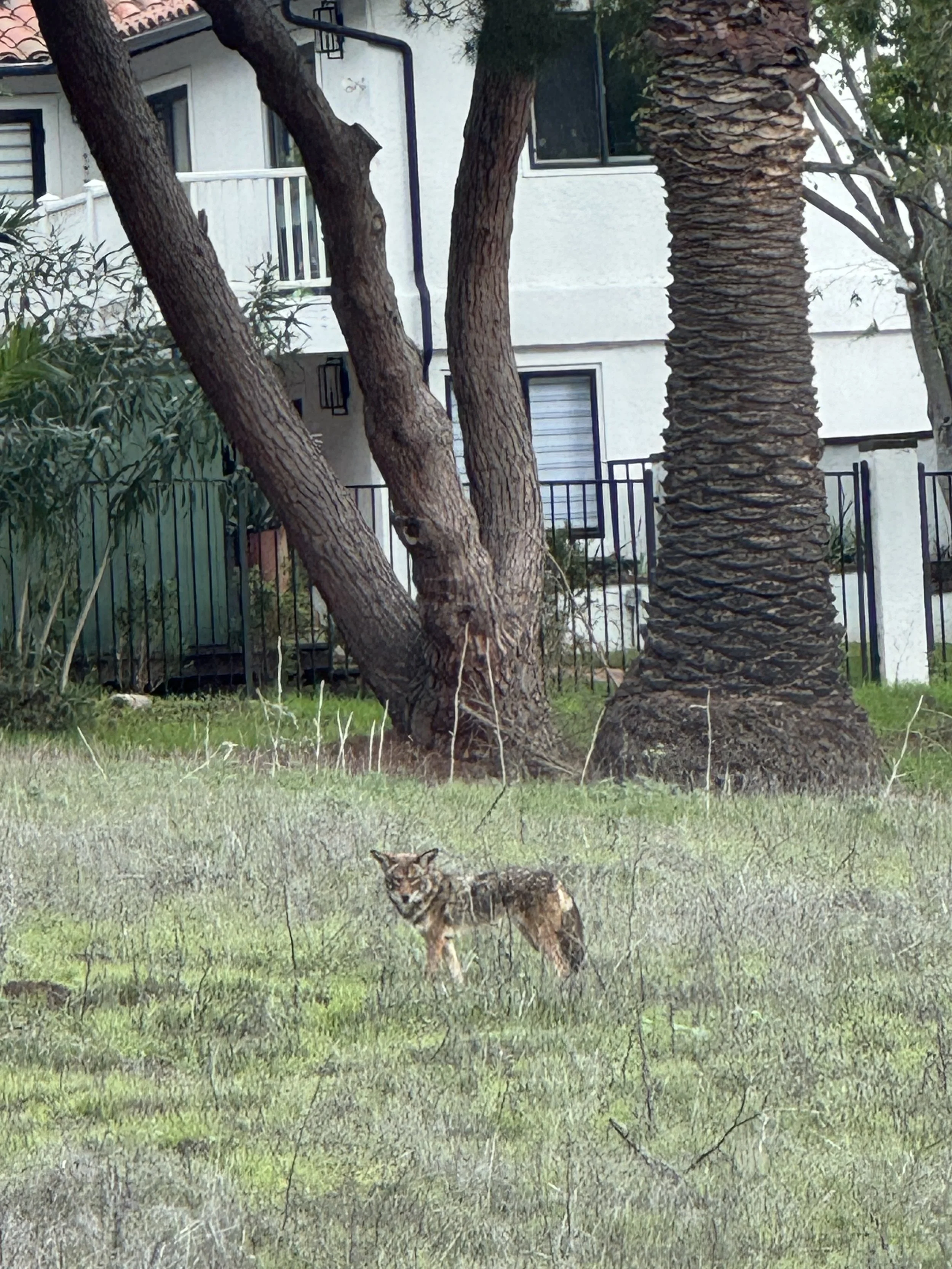
Coyotes can appear in canyons, preserves, trails, yards and even the middle of a quiet residential street. Their presence can feel beautiful, surprising and unnerving at the same time. Understanding their behavior is the first step toward safer coexistence.
At a Glance
Quick Facts About Palos Verdes Coyotes
Native and Adaptable
Coyotes are native to California and have lived in this region since before the Peninsula’s modern residential development.
Canyons and Neighborhood Edges
They favor open space, preserves, canyon corridors and natural habitat, but may move through residential streets and yards while traveling or looking for food.
Often Dusk to Dawn
Coyotes are frequently noticed at dusk, overnight and around sunrise, although seeing one during daylight does not automatically mean it is sick or aggressive.
Opportunistic Omnivores
Their diet can include rodents, rabbits, insects, fruit, vegetation, carrion and other available food. Unprotected pets and backyard animals can also be at risk.
Pairs and Family Groups
Coyotes commonly live as territorial pairs or family groups. Adults cooperate in raising and feeding their pups.
Respect, Distance and Prevention
Never feed a coyote. Protect pets, remove attractants, maintain a safe distance and reinforce a coyote’s natural caution around people.
Cliff’s Notes
Beautiful, Wild and Sometimes Unnerving
Living on the Palos Verdes Peninsula means living unusually close to nature for Los Angeles County. Coyotes are part of that experience. It can still be shocking to see one walking or running down a residential street, especially in a place where you were not expecting it.
Our family has always treated coyotes with respect. We keep our distance, remain aware of our surroundings and protect smaller pets. At the same time, it is difficult not to appreciate how athletic, intelligent and majestic they can be.
Cliff’s Notes Take
“Coyotes are controversial because the risks are real, particularly for cats and small dogs. But after living here for a long time, I am glad they remain part of the Peninsula’s ecosystem. Kimberly, Clover and I value the opportunity to be this close to nature. Along with the peacocks, owls and other wildlife, coyotes remind us that Palos Verdes is still connected to something genuinely wild.”
Some nights we can hear coyotes howling, yipping and cackling from our home and across the canyons. The sound can be unsettling. It can also be an extraordinary reminder that, despite being surrounded by a major metropolitan area, the Peninsula retains meaningful open space and wildlife habitat.
Coexistence does not mean ignoring legitimate safety concerns. It means understanding the animal, avoiding behavior that encourages habituation and taking practical steps to protect people and pets.
Local Habitat
Where Do Coyotes Live on the Palos Verdes Peninsula?
Coyotes do not recognize city boundaries. They move through connected habitat across Palos Verdes Estates, Rancho Palos Verdes, Rolling Hills Estates, Rolling Hills and neighboring Peninsula communities.
Canyons and Preserves
Canyons, coastal sage scrub, preserve land and undeveloped slopes provide cover, prey, denning opportunities and travel corridors.
Trails and Equestrian Areas
Trail systems and open equestrian landscapes can connect larger habitat areas. Coyotes may use these corridors during quieter hours.
Golf Courses and Large Properties
Open grounds, mature landscaping, water sources and rodents can make golf-course edges and larger residential properties attractive travel or foraging areas.
Residential Streets and Yards
Coyotes may pass through neighborhoods while moving between habitat areas. Food, fallen fruit, unsecured trash, outdoor pet food, water and dense brush can encourage them to linger.
Cliff’s Notes Take
“A coyote walking down a street does not necessarily mean it lives on that street. Many Peninsula neighborhoods sit beside canyons, trails and open-space corridors. The animal may simply be moving through a route that existed long before the homes around it.”
Background
Coyote History and Their Role in the Ecosystem
Coyotes are not newcomers to Palos Verdes. They are native to California and were present before the Peninsula was extensively developed. Their intelligence, flexible diet and ability to adapt have allowed them to persist as roads and residential neighborhoods expanded around remaining natural habitat.
Historically, coyotes were heavily persecuted throughout North America. Yet the species proved remarkably resilient and expanded its range. Today, coyotes can live in remote wilderness, agricultural areas, suburbs and major urban regions.
On the Peninsula, their ecological role includes hunting rodents, rabbits and other small animals, consuming carrion and responding to the seasonal availability of fruit and vegetation. Their presence is part of a larger food web rather than an isolated wildlife issue.
Rodent Control
Coyotes consume rodents and other small mammals, helping influence prey populations within natural and residential-edge environments.
Flexible Diet and Habitat
They can adjust their movement and diet to local conditions, which is one reason they function so successfully in a wildland-urban interface.
Our Habits Shape Theirs
Feeding, unsecured food and a lack of response to close approaches can teach coyotes that homes and people offer rewards without consequences.
The Peninsula at Night
What Does Coyote Howling, Yipping and “Cackling” Mean?
The dramatic chorus residents hear at night is usually communication. Coyotes use howls, yips, barks, whines and growls to locate family members, maintain contact, greet one another, warn of danger, defend territory and communicate around pups or dens.
Important clarification: A burst of excited yipping does not reliably mean coyotes have made a kill. That is a common assumption, but their calls are primarily a communication system. Without direct visual evidence, the sound alone cannot tell us that an animal was attacked.
The family’s description of the sound as a kind of “party” is understandable. A greeting chorus can sound energetic, social and celebratory. Multiple voices, rapid changes in pitch and the way sound travels through a canyon can also make a small family group sound like a much larger pack.
Long Howls
Often used to announce location, maintain contact across distance or communicate territorial presence.
Rapid Yips and Howls
May occur during greetings or group communication. The overlapping voices can create the impression that many more coyotes are present.
Barks
Can communicate alarm, warning or agitation, depending on the circumstances and surrounding behavior.
Whines and Other Close-Range Sounds
Can be part of social interaction between family members, mates or pups.
Numbers and Trends
How Many Coyotes Live on the Peninsula?
There is no reliable, publicly available current census of every coyote living across the entire Palos Verdes Peninsula. Coyotes move between jurisdictions, use large territories, travel at night and can be counted more than once when residents report sightings.
Rancho Palos Verdes maintains a sighting-report system, a live activity map and historic reporting data. These records are valuable for identifying locations and patterns, but reported sightings are not the same as a population count.
One Animal, Many Reports
A single coyote moving through several streets may generate multiple reports during one morning or evening.
Seasonal Activity Matters
Adults may become more active while feeding pups in late spring and summer. Changes in weather, prey and human activity can also affect visibility.
Territory and Resources Matter
Coyote family size and reproduction can respond to food availability, territory and population pressure. Vacant habitat may also be occupied by transient coyotes.
Cliff’s Notes Take
“A week with more neighborhood posts or street sightings does not necessarily prove that the Peninsula’s coyote population suddenly grew. It may reflect seasonal movement, the same animals being seen repeatedly or more residents reporting what they observe.”
Reading the Situation
Normal, Concerning and Emergency Coyote Behavior
Seeing a coyote can feel alarming, but the animal’s behavior and the surrounding circumstances matter more than the sighting alone.
| Observed Behavior | What It May Mean | Recommended Response |
|---|---|---|
| Moving through a street, trail or open area | Normal travel or foraging behavior | Maintain distance, supervise pets and do not approach or follow |
| Seen during daylight | Not automatically abnormal; coyotes can be active during the day | Assess the complete behavior rather than the time alone |
| Pausing to watch from a distance | Curiosity or assessment of its surroundings | Keep pets close, give it space and haze if it remains in a residential area |
| Repeatedly lingering near homes or approaching people | Possible habituation or access to food, water or shelter | Remove attractants, haze consistently and report recurring behavior |
| Following a person walking a dog | May involve territorial or defensive behavior, particularly near pups or a den | Do not run; keep the dog close, make yourself large, leave calmly and report the incident |
| Growling, lunging, attacking or showing no fear during a close encounter | Potentially aggressive or dangerous behavior | Protect yourself, seek immediate help and contact the appropriate local authority |
| Appearing injured, disoriented, lethargic or severely ill | Possible injury or illness | Keep away and contact animal-control authorities |
Practical Guidance
What Should You Do If You Encounter a Coyote?
If a coyote is moving away at a safe distance, allow it an escape route and keep your distance. If it remains close, approaches or appears too comfortable in a residential setting, assertive hazing can help reinforce its natural caution around people.
- Stay calm and do not run. Running can trigger pursuit behavior and leaves you with less awareness of the animal.
- Bring children and pets close. Pick up a very small dog if you can do so safely. Keep larger dogs on a short, controlled leash.
- Make yourself look larger. Stand tall, face the coyote and raise your arms or open your jacket.
- Use a firm, loud voice. Shout, clap or make other forceful noise. The goal is to make the coyote uncomfortable around people.
- Increase pressure if it does not leave. From a safe position, use available noise-making methods or throw objects toward the ground near the animal rather than attempting to injure it.
- Give it a clear escape route. Never corner a coyote or move toward pups or a possible den.
- Leave carefully. Back away without turning your back until you have adequate distance.
- Report concerning behavior. Recurring, unusually bold or aggressive activity should be documented through the appropriate city reporting system.
Emergency: If a coyote attacks a person, a person is bitten or there is an immediate threat to human safety, call 9-1-1.
Pets and Property
How to Protect Dogs, Cats and Backyard Animals
The greatest practical concern for many Palos Verdes families is pet safety. Coyotes pose a more significant risk to domestic animals—especially cats, small dogs and unprotected backyard animals—than they generally do to people.
Supervise Outdoor Time
- Do not leave small dogs unattended outside, even in a fenced yard.
- Use a standard, controlled leash near canyons, trails and open space.
- Be especially attentive around dawn, dusk and nighttime.
- Carry a whistle, flashlight or other appropriate noise-making tool.
- Avoid allowing a dog to chase or confront a coyote.
Keep Cats Indoors
- Indoor living is the most reliable protection, particularly overnight.
- Do not assume a high wall or familiar yard eliminates risk.
- Enclosed outdoor cat patios can offer fresh air with greater protection.
- Bring cats inside before dusk rather than waiting until late at night.
Remove Attractants
- Feed pets indoors and remove outdoor bowls promptly.
- Use secure trash containers with tight-fitting lids.
- Do not intentionally feed coyotes or other wildlife.
- Collect fallen fruit and clean outdoor cooking areas.
- Manage birdseed and other food that may attract rodents.
Reduce Cover and Access
- Trim dense brush and vegetation that can provide cover.
- Address gaps beneath gates, fences and structures.
- Secure chickens and other backyard animals in predator-resistant enclosures.
- Eliminate unnecessary outdoor water sources.
- Inspect the yard before letting a small pet outside at night.
Cliff’s Notes Take
“With a small dog such as Lollipop, our family does not treat the backyard as automatically safe after dark. Supervision, lighting and a quick look around are simple habits, but they matter when you live near Peninsula wildlife corridors.”
Community Response
How Coyotes Are Managed Locally
Local coyote management is centered primarily on coexistence, public education, reporting, behavior modification, attractant removal and a tiered response to increasingly concerning conduct.
Rancho Palos Verdes has a formal Coyote Management Plan designed to support coexistence with urban coyotes. Its approach emphasizes prevention and nonlethal controls while recognizing that aggressive behavior requires a different level of response.
Local management depends on participation by residents, city staff, homeowners associations and wildlife authorities. Reporting helps agencies identify repeated activity and distinguish ordinary sightings from meaningful public-safety patterns.
Remove the Reward
Food, water, unsecured waste, fallen fruit, rodents and shelter can encourage coyotes to return to a property.
Discourage Habituation
Consistent, appropriate hazing teaches coyotes that residential areas and close contact with people are uncomfortable.
Behavior Determines Action
A passing sighting is different from repeated approach behavior, an attack on a pet or direct aggression toward a person.
Do not attempt to trap, poison, relocate, injure or personally manage a coyote. Wildlife laws and agency procedures apply. Contact the appropriate city, county or state authority when intervention may be necessary.
Living in Palos Verdes
Wildlife as Part of the Peninsula Lifestyle
The Palos Verdes Peninsula offers a rare relationship between residential life and open space. Buyers are often drawn here for ocean views, larger lots, trails, mature trees, equestrian character and a feeling of separation from greater Los Angeles. Wildlife is part of that landscape.
Everyday Outdoor Connection
Families who value trails, open space and outdoor exploration often see local wildlife as part of the educational and emotional appeal of Peninsula life.
Beauty with Responsibility
Trail access and walkable neighborhoods are major lifestyle benefits, but pet owners should understand local wildlife patterns and use thoughtful precautions.
Canyon and Preserve Adjacency
Homes near natural corridors can offer privacy, views and tranquility while also bringing residents closer to coyotes, owls, peacocks and other wildlife.
Cliff’s Notes Take
“Local knowledge is not limited to prices and square footage. It includes understanding how a street feels at night, where trails and canyon corridors connect, what wildlife residents encounter and what responsible ownership looks like in that setting.”
Explore more of the Peninsula’s natural character through our guides to the owls of Palos Verdes, Frog Creek in Palos Verdes Estates and Del Cerro Park in Rancho Palos Verdes.
Official Information
Reporting and Local Coyote Resources
Contact information and procedures can change. Use the official city and wildlife-agency pages below for the most current instructions.
-
Rancho Palos Verdes Coyote Sighting Portal
Report sightings, review local guidance and access the city’s activity map. -
Rancho Palos Verdes Coyote Information
City information covering habitat, behavior, management and reporting. -
Rancho Palos Verdes Coyote Management Plan
Review the city’s coexistence and tiered-response framework. -
Palos Verdes Estates Coyote Information
Access current PVE reporting and public-safety guidance. -
Rolling Hills Estates Coyote Management
Local reporting and management information for Rolling Hills Estates. -
California Department of Fish and Wildlife
State wildlife information and guidance for serious wildlife conflicts.
Immediate danger: Call 9-1-1 if a person is attacked, bitten or facing an immediate threat. In Palos Verdes Estates, urgent or aggressive coyote behavior may also be reported to the Palos Verdes Estates Police Department at (310) 378-4211. Residents should confirm current nonemergency contacts through their city’s official website.
People Also Ask
Palos Verdes Coyote FAQ
Are coyotes native to the Palos Verdes Peninsula?
Yes. Coyotes are native to California and were present in the region before modern development. Peninsula neighborhoods were built around and beside habitat that coyotes have used for generations.
Where are coyotes most commonly seen in Palos Verdes?
They may be seen near canyons, preserves, trails, golf courses, equestrian areas, larger properties and residential streets that connect natural corridors. Sightings occur across Palos Verdes Estates, Rancho Palos Verdes, Rolling Hills Estates and Rolling Hills.
Does seeing a coyote during the day mean it has rabies?
No. Coyotes can be active during daylight, especially when traveling or feeding pups. Focus on the animal’s complete behavior. Disorientation, severe lethargy, unusual physical symptoms or unexplained aggression should be reported to the appropriate authority.
Does loud coyote yipping mean they made a kill?
Not necessarily. Howling, yipping and barking are primarily forms of communication used for greetings, location, group contact, warnings and territorial signaling. The sound alone is not reliable evidence of a kill.
Why can a few coyotes sound like a large pack?
Coyotes produce overlapping calls at different pitches, and canyon acoustics can amplify or scatter the sound. A relatively small family group can therefore sound much larger than it is.
How many coyotes live on the Palos Verdes Peninsula?
There is no dependable current public census for the entire Peninsula. Sighting reports help identify activity patterns but cannot be treated as a direct population count because the same animals may be reported repeatedly and move between cities.
Are Palos Verdes coyotes dangerous to people?
Most coyotes avoid people, but every wild animal should be treated with caution. Never approach or feed one. Report repeated close approaches, threatening behavior or aggression, and call 9-1-1 during an immediate threat or attack.
Are small dogs and cats at risk?
Yes. Cats, small dogs, chickens and other unprotected animals can be vulnerable. Keep cats indoors, supervise small dogs outside, use a controlled leash and avoid leaving pets unattended after dark.
Can coyotes get over residential fences?
Coyotes are capable jumpers and climbers, and they may also use nearby objects or gaps beneath fencing. A conventional fence should not be treated as a guarantee that a small pet is safe when left unattended.
What attracts coyotes to a yard?
Outdoor pet food, unsecured trash, fallen fruit, water, compost, rodents, birdseed, dense vegetation and unprotected backyard animals can all provide food, prey, water or shelter.
Should I run if I encounter a coyote?
No. Stay calm, bring children and pets close, make yourself look large, use a firm voice and back away while giving the animal an escape route. If it remains too close in a residential area, use appropriate hazing techniques.
Should every coyote sighting be reported?
Follow the guidance of the city where the sighting occurred. Rancho Palos Verdes encourages residents to report sightings through its online portal so the city can track activity and trends. Aggressive, recurring, injured or unusually bold animals should always receive prompt attention.
Local Knowledge Matters
Thinking About Living in Palos Verdes?
Understanding the Peninsula means understanding more than homes. It means knowing the streets, microclimates, trails, open spaces, wildlife corridors and day-to-day lifestyle differences that shape each neighborhood.
This guide is intended as general educational information and is not a substitute for current instructions from law enforcement, animal-control personnel or wildlife authorities. Wildlife behavior is unpredictable. Always prioritize personal safety and consult the appropriate agency regarding a specific incident.
